

A PLAIN-ENGLISH REPORT CHECKLIST
Before drawing a conclusion from a security score, take a moment to ask what the report actually shows.

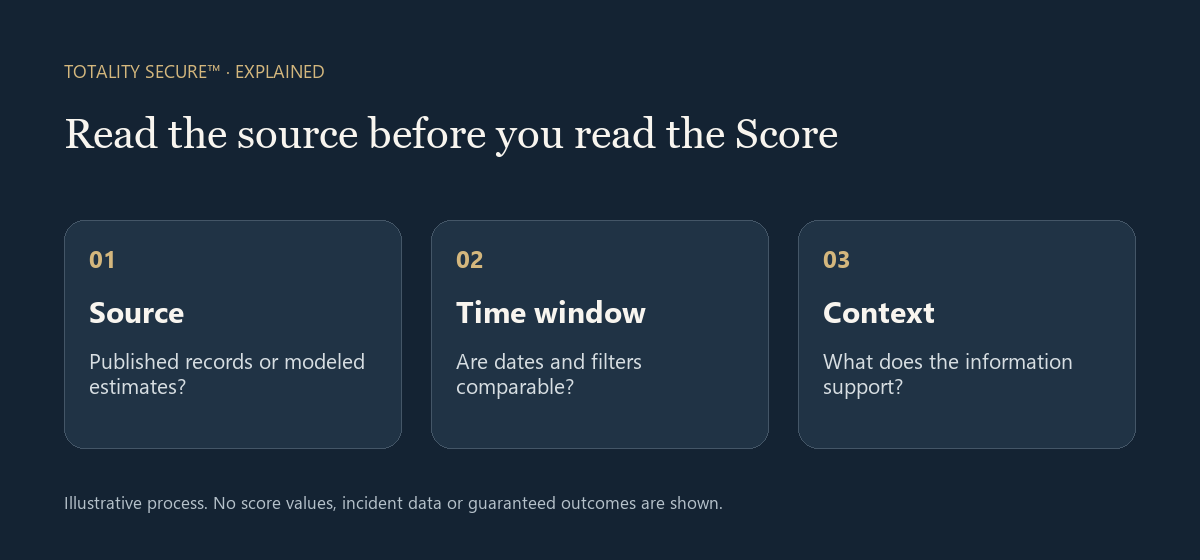
1. Where does this information come from?
A score is easier to understand when its source is clear. The Totality Secure Score™ presents an address-level 0–100 rating with incident context, maps and a source label.
Start with that label. Direct municipal feeds cover selected metropolitan areas. A result labeled Regional risk model uses estimates rather than verified records of individual incidents. Those are different kinds of evidence.
The platform’s source disclosure also explains that information may be delayed, incomplete or mapped approximately. No results on a map does not necessarily mean no incidents occurred.
2. What time period am I looking at?
Seven days and a full year tell different stories. Check the selected dates before comparing a report with an earlier result or another location. Keep the time window and radius consistent, and note whether the source has changed.
Published reporting is not a live view of everything happening nearby. The FBI’s crime reporting resources provide background on how agency submissions contribute to broader crime statistics. A change in coverage or reporting can affect the picture.
Read the video transcript
The number is a starting point
Read the source label before interpreting the Totality Secure Score™ or its map.
Records and estimates differ
Municipal feeds contain published incident records. A Regional risk model uses estimates instead.
Compare like with like
Keep the date window, radius and filters consistent. Check coverage and approximate locations.
Keep the limits in view
A score is informational. It does not predict future incidents or guarantee safety.
3. What does nearby mean here?
An incident within the selected radius is not necessarily an incident at the address you searched. Review distance, incident type and any location caveats before drawing a conclusion about a particular property.
The Score’s public explanation describes incident history, the nature of reported incidents and proximity as part of its proprietary analysis. Our fuller guide to reading address-level security information explains how to put those pieces together without treating a score as a prediction.
4. Am I combining different types of information?
Crime incident records and sex offender registry records are not interchangeable. Megan’s Law information comes from public registry systems and must be checked against the responsible jurisdiction’s current records.
The current address-level Totality Secure Score™ app does not include a registry feed. If you want to review registry information separately, begin with the official national search resource. Availability varies, and a listing is not a prediction of future conduct. Do not turn separate sources into a claim the report itself does not make.
5. What reasonable next step does this support?
A report can prompt useful questions: is an entrance poorly lit, is exterior coverage understood, or does a concern need verification? It cannot promise what will happen next or determine a person’s suitability for housing, employment or insurance.
The Totality Secure™ Safe Neighborhoods Program™ gives participating neighborhoods a structure for reviewing exterior coverage and progress. Its recurring Community Secure Score™ reports are distinct from the address-level app. Both encourage an informed conversation, but the scores should not be treated as interchangeable.
Use our practical neighborhood security planning guide to turn that conversation into a short list of actions. Track completed work separately from changes in reported incidents; an improvement project does not guarantee a higher Score.
Ready to review your own report? Open the Totality Secure Score™ app and start with the source label. Keep its limitations and permitted uses in mind throughout.
Read the video transcript
Give information a useful job
Use available context to ask a specific question about your neighborhood.
Review what you can improve
A lighting concern or exterior coverage gap can become a practical discussion.
Record the work separately
Track completed actions separately from changes in incident reports or scores.
Review and keep learning
A completed project does not prove it caused a change in crime. Revisit the information with context.
Common questions
Does a higher Score guarantee safety?
No. The Score is informational and reflects the data and analysis used for a selected location and date range. It does not predict future incidents.
Can I compare reports from different dates?
You can review them, but meaningful comparisons require consistent date windows, radius, filters and source types. Note any change in coverage.
Where should I check Megan’s Law information?
Use official registry resources, starting with the national public registry search and the responsible jurisdiction. The current address-level Score app does not include a registry feed.